

A. K. Shiva Kumar
Steering Committee Member, IWWAGE

Arti Ahuja
IAS (Retd.); Steering Committee Member, IWWAGE
Bharath Sundaram
Steering Committee Member, WELL Labs

Bishnu N. Mohapatra
Steering Committee Member, IWWAGE

D. Sundaram
Member, Governing Council, Krea University

Deepanshu Khandelwal
Chief Executive Officer, Catalyst AIC
Dr. Rajivan Krishnaswamy
Chairperson, IRB

Farzana Afridi
Steering Committee Member, IWWAGE
Hemalatha Ramkumar
Legal & Compliance Manager

Jagdeesh Rao
Steering Committee Member, WELL Labs

Jennifer Newson
Steering Committee Member, Sapien Labs

Kapil Viswanathan
President, IFMR Member, Governing Council, Krea University
Lakshmanan Nataraj
AI and Technology Expert

Mukund Padmanabhan
Steering Committee Member, Deccan Centre
Nayanthara Kothari
Director, Kothari Safe Deposits Ltd

R. Seshasayee
Member, Governing Council, Krea University

Rajendra Thakur
Executive Director, Centre for Digital Financial Inclusion (CDFI)
S. Krishnan
Secretary, Ministry of Electronics and Information Technology (MeitY), Government of India

S. Mahalingam
Chairman and Former Chief Financial Officer & Executive Director, Tata Consultancy Services

Saachi Bhalla
Steering Committee Member, IWWAGE

Shailender Swaminathan
Director, Sapien Labs Centre for Human Brain and Mind

Sharon Buteau
Executive Director, LEAD at Krea University

Sharon Marie Barnhardt
Steering Committee Member, IWWAGE

Shloka Nath
Steering Committee Member, WELL Labs
Shobhini Mukerji
Executive Director, J-PAL South Asia

Shyam Sudhakar
Steering Committee Member, Sapien Labs

Soumya Pal
Steering Committee Member, IWWAGE
Sujatha Viswanathan
Chief Financial Officer

Sushila Varma
Executive Director, IWWAGE

T. S. Tirumurti
Head, Steering Committee, Deccan Centre for International Relations, IFS (Retd.)

Tara Thiagarajan
Steering Committee Member, Sapien Labs

Upmanu Lall
Steering Committee Member, WELL Labs

Uttara Bharath Kumar
Steering Committee Member, Sapien Labs

Veena Srinivasan
Executive Director, WELL Labs

Vinay Nagaraju
Executive Director, Inclusion Economics India Centre

Vishwanathan Iyer
Steering Committee Member, Deccan Centre
Our Journey
Laying the Foundation
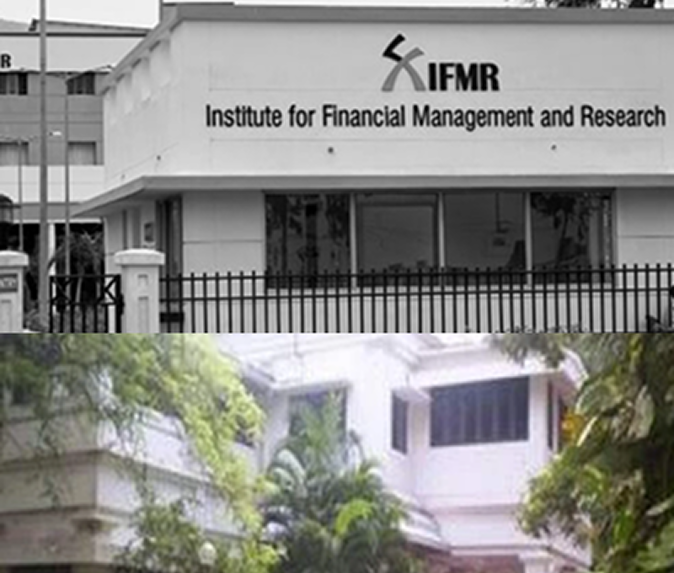
IFMR is established at a pivotal moment in India’s journey, with a focus on advancing financial research, management and executive education, following an initiative led by the Industrial Credit and Investment Corporation of India (ICICI). ICICI provides seed capital, with the C. M. Kothari Charitable Trust joining as a co-sponsor and institutions across banking, industry and the public sector contributing to its establishment.
Madras, now Chennai, is a deliberate choice. IFMR is conceived as an all-India institution serving both public and private sectors, connecting research with practice and India with the wider world. Its first training programme is inaugurated in 1971, and the University of Madras subsequently recognises IFMR for doctoral research in finance.

Connecting Knowledge and Practice
IFMR expands its role as a bridge between academic knowledge and practice, with work spanning public finance, monetary policy, banking, markets and corporate finance. Its executive programmes bring together bankers, executives and civil servants from India and across the Commonwealth, strengthening its engagement with government and industry.
The institute’s research and impact footprint also expands during this period, with specialised centres emerging around new areas of policy and development. The Centre for Micro Finance is established in 2005, followed by the Centre for Development Finance, and Small Enterprise Finance Centre. In 2007, J-PAL South Asia is established at IFMR, strengthening a growing ecosystem connecting rigorous research with policy and development practice.
From Institution to Ecosystem
The institute’s education and research activities expand in scale and scope. The Sri City campus is inaugurated in 2014, while specialised research centres and initiatives deepen IFMR’s engagement with a wider range of development challenges.
A distinctive model begins to take shape: globally connected, but locally anchored. IFMR collaborates with leading academics and research institutions around the world while investing in local research capacity—nurturing Indian researchers and teams to lead projects, build deep contextual knowledge and develop sustained relationships with communities and public institutions.
By 2016, IFMR had grown into a diverse research ecosystem, bringing together specialised institutions and expertise across research, education and practice, with evidence increasingly connected to programme design, policy and systems strengthening.

Reimagining Higher Education and Pursuing New Frontiers
Building on its experience in research and management education, IFMR enters a new institutional chapter with the establishment of Krea University: a new-age institution conceptualized by eminent academics, business leaders and institution builders, to nurture the next generation of critical thinkers.
J-PAL co-founders Abhijit Banerjee and Esther Duflo, together with Michael Kremer, receive the 2019 Nobel Prize in Economic Sciences. IFMR’s early collaboration with the Poverty Action Lab at MIT helps advance research in India that contributes to this wider body of work.
IFMR continues to expand its institutional response as new societal challenges and areas of inquiry emerge. During this period, the Catalyst Atal Incubation Centre is incubated to support entrepreneurship and innovation for social impact. The Institute for What Works to Advance Women and Girls (IWWAGE) is incubated under LEAD in 2018 to advance evidence and action on women’s economic opportunities; the Sapien Labs Centre for Human Brain and Mind is established in 2022; and WELL Labs joins hands with IFMR in 2023, extending its mandate into the water, environment, land and livelihoods sectors.
In 2026, the Deccan Centre for International Relations, IFMR’s ninth centre and first dedicated to international relations is launched, to advance the regions geopolitical agenda.

